Scepter of sovereignty
The KillerThe Scepter of sovereignty is both the instrument of Duncan’s healing rite and a visible sign of the authority invested in him. Blessed by the Monk and used to touch the sick, it accompanies a public sequence of recoveries; when Macbett and Banco bring Duncan down, the scepter falls away from him with the crown, turning an emblem of royal power into part of the choreography of his overthrow.
Blessing and transfer
The scepter enters the rite through a chain of delegated authority. The Officer hands it to the Monk, who describes healing as a gift transmitted through him by the Lord God. His prayer asks for bodily sickness to be cured alongside jealousy, pride, luxury, and the striving after power. The healing office is therefore presented as spiritual as well as physical, while its concern with power foreshadows the political violence that will interrupt the ceremony.
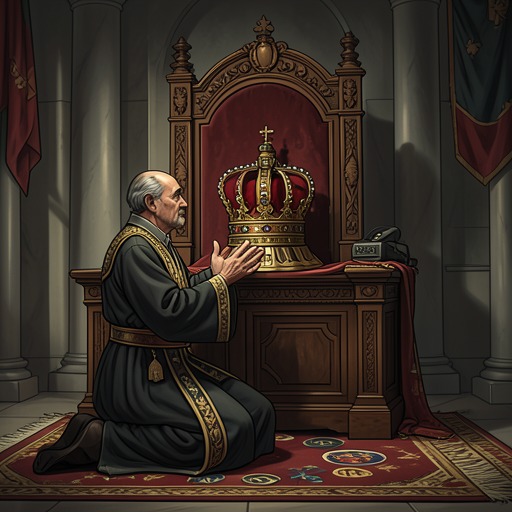
After further prayers for peace and the restraint of destructive forces, the Monk blesses the scepter and directs Duncan to use it to touch the sick. Duncan then mounts the throne and sits as the patients are brought in. The staging makes the object’s significance legible through its passage between hands: it is handled by the Officer and the Monk before Duncan exercises the power associated with it. The rite joins religious blessing, royal position, and physical contact in one public action.
The healing touch
The first patient’s account gives the cure a specific bodily and social context. He describes a long journey across an ocean, a continent, seven countries, another sea, and mountains before reaching the damp, sunless valley where he lives. He says that the damp has eaten away his bones and describes scrofula, tumors, and pustules across his body. His suffering has also separated him from his family: his wife and children cannot bear him to come near them. He asks Duncan to save and cure him.
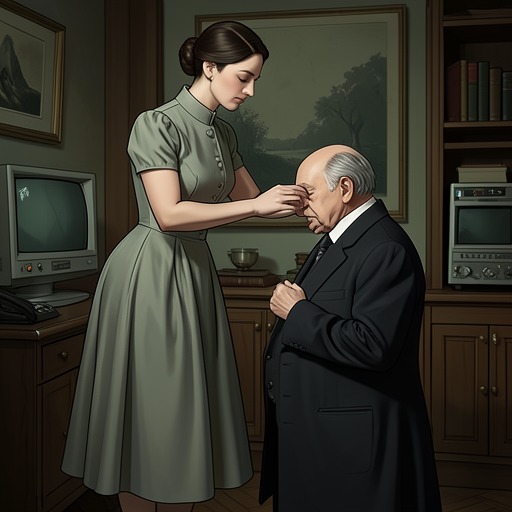
Duncan promises to cure him and touches his head with the scepter. His words connect the act to the grace of Jesus Christ and to the power vested in him that day; he absolves the patient of sin affecting soul and body and wishes him purity. The scene presents recovery as immediate and unmistakable. The man stands, turns toward the audience, drops his stick, raises his hands to heaven, and leaves smiling and shouting for joy. The scepter is not merely mentioned as a badge of office: its contact is the decisive action at the turning point from illness and isolation to visible relief.
Repeated recoveries
The ceremony extends beyond the first cure. After the Officer calls for the next patient, a third sick man approaches Duncan and is cured in the same way; fourth, fifth, sixth, and successive patients follow, up to the tenth and eleventh. Each enters from stage right and exits to the left after Duncan touches them with the scepter. The Officer’s repeated call organizes the rite as a procession, making the object’s function recurrent and public rather than a single private encounter.
The patients’ conditions are not all specified, though some use crutches or wheelchairs. Their repeated entrances and exits emphasize the rite’s apparent efficacy, while the first patient’s detailed account supplies the concrete experience that the later sequence does not individualize. The scepter thus links a particular plea for relief to a larger spectacle of royal healing: a touch is repeated, and patient after patient passes through the scene.
Loss of the scepter
The object’s meaning changes sharply when the ceremony gives way to violence. As Duncan backs toward the throne and the others close around him, Lady Duncan snatches off his cloak. Duncan retreats up the steps, trying to cover his exposed body with his arms. The scepter falls one way and the crown another as Macbett pulls him down; Banco strikes the first blow.
The paired fall separates Duncan from the instruments and signs of kingship at the moment his body is overcome. Earlier, the scepter had been placed in Duncan’s hand so that he could confer healing before an assembled succession of patients. Now it lies apart from him as his attackers bring him to the ground. The contrast does not undo the earlier cures, but it closes the rite with a reversal: the object through which Duncan’s authority was made active cannot protect him from the violence that ends his command.